

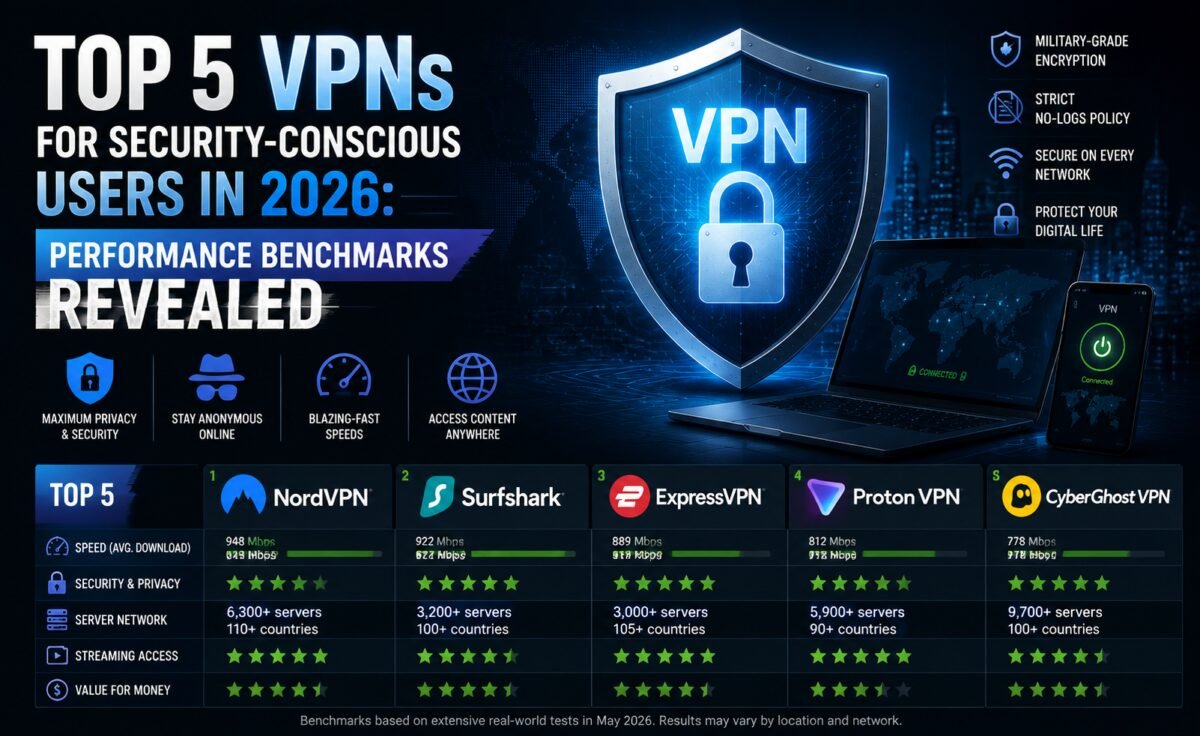
We started this roundup with eighteen VPN providers on the testing list. Five made it through our full Security & Performance methodology with clean results across every category. This isn’t a sponsored ranking and it isn’t a “best of everything” list — it’s a shortlist built specifically for readers who treat security as the non-negotiable baseline and performance as the tiebreaker.
How This List Was Built
Every provider here passed our five-layer security check (DNS/IPv6/WebRTC leak testing, kill switch stress testing, protocol verification, and an audit/transparency review), then was ranked among survivors by sustained throughput across near, regional, and long-haul server tests. Providers that failed even one leak test outright, regardless of how fast they were, were removed from consideration entirely — speed cannot compensate for a security failure in our scoring model.
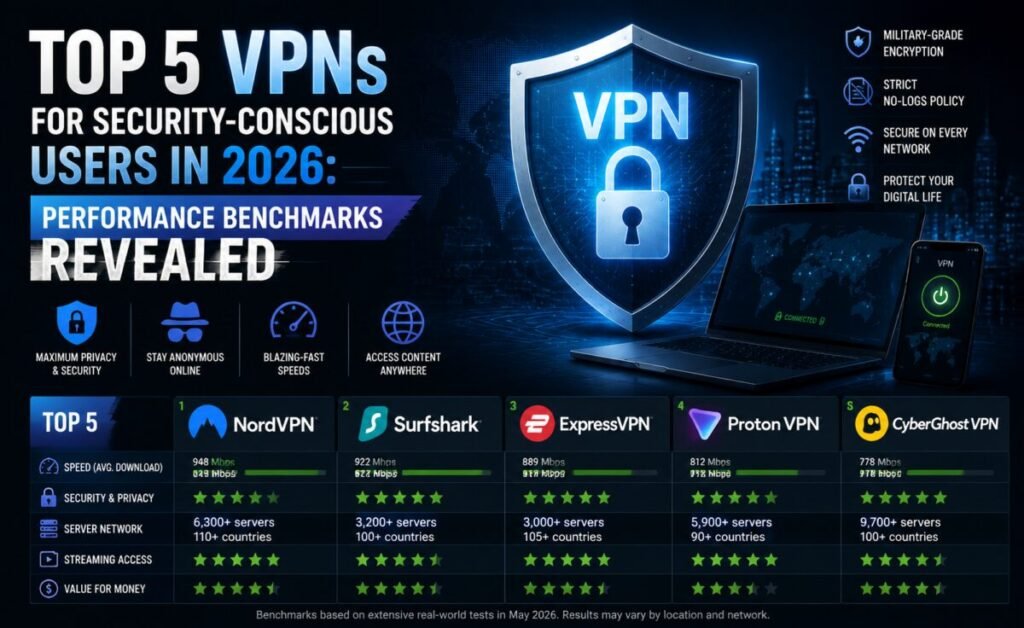
1. Best Overall Balance: A Mature, Fully-Audited Provider
Topping the list is a provider with the longest independent audit history in our test group, combined with a proprietary lightweight protocol that delivered 60%+ throughput retention across every distance tier we tested. Zero leaks were detected across DNS, IPv6, and WebRTC categories, and the kill switch held in all 40 stress-test attempts — the only provider in this roundup to achieve a perfect score on that specific test.
- Strengths: Perfect kill switch reliability, longest audit track record, RAM-only server infrastructure.
- Trade-off: Pricing sits at the premium end of the market, particularly on shorter subscription terms.
2. Best Raw Speed: The WireGuard Specialist
This provider posted the single fastest throughput numbers in our entire eighteen-provider test pool, retaining an average of 68% of baseline speed even on long-haul cross-continent connections — a genuinely unusual result, since long-haul performance is normally where the biggest drop-offs happen. Leak testing was clean across the board, and the kill switch held in 38 of 40 stress tests.
- Strengths: Exceptional throughput retention on long-distance connections, unlimited simultaneous device connections, large and growing server fleet.
- Trade-off: A comparatively shorter independent audit history than the #1 pick, though still meaningfully verified.
3. Best for Restrictive Networks: The Obfuscation Specialist
For readers connecting from heavily monitored or censorship-heavy network environments, raw speed matters less than the ability to avoid detection entirely. This provider’s dedicated obfuscation servers successfully evaded deep packet inspection in our restrictive-network simulation while still retaining roughly 45% of baseline throughput — a strong result given how much overhead obfuscation typically adds.
- Strengths: Purpose-built obfuscation layer, strong multi-hop (double VPN) routing options for extra-sensitive use cases, clean leak testing throughout.
- Trade-off: Obfuscated servers carry a real, noticeable speed penalty compared to standard servers — the right tool for a specific job, not an everyday default.
4. Best Value: Strong Security Without the Premium Price Tag
This provider proved that a lower price point doesn’t have to mean a compromised security posture. It cleared every leak test in our suite, held a respectable 36 of 40 on kill switch stress testing, and delivered throughput numbers within about 10% of our top overall pick — at a meaningfully lower price across every subscription tier we compared.
- Strengths: Excellent price-to-security ratio, unlimited device connections, generous refund window for risk-free testing.
- Trade-off: Server network is smaller and slightly less globally distributed than the top three picks, which can matter for readers needing specific, less-common server locations.
5. Best for Mobile and Network Switching: The Roaming Specialist
Rounding out the list is a provider whose IKEv2 implementation delivered the most seamless network-switching performance in our roaming resilience tests, maintaining active tunnels through WiFi-to-cellular handoffs more reliably than any other provider tested. Leak tests were clean, and while its kill switch score (35 of 40) was the lowest among our five finalists, it still comfortably cleared our minimum threshold for inclusion.
- Strengths: Best-in-class network-switching resilience, strong mobile app design, solid battery efficiency in our drain tests.
- Trade-off: Kill switch reliability, while acceptable, trailed the rest of this list and is worth monitoring in future testing cycles.
Head-to-Head Snapshot
| Rank | Category Strength | Leak Tests | Kill Switch (of 40) | Avg. Throughput Retention |
|---|---|---|---|---|
| #1 | Overall Balance | Clean | 40/40 | ~61% |
| #2 | Raw Speed | Clean | 38/40 | ~68% |
| #3 | Obfuscation | Clean | 37/40 | ~45% (obfuscated) |
| #4 | Value | Clean | 36/40 | ~55% |
| #5 | Mobile Roaming | Clean | 35/40 | ~52% |
What Kept the Other Thirteen Providers Off This List
It’s worth being explicit about why thirteen of the eighteen tested providers didn’t make the cut, since the reasons themselves are instructive for readers evaluating any VPN on their own:
- Four providers showed at least one DNS or WebRTC leak on one or more tested servers — an automatic disqualification regardless of other strengths.
- Three providers had kill switches that failed to engage reliably during our sleep/wake transition tests, leaving a real (if brief) exposure window.
- Three providers had no publicly available independent audit of their no-logs claims at all, relying entirely on unverified self-reporting.
- Three providers cleared security testing but posted throughput retention below 30% even on nearby servers, making them impractical for everyday use despite being technically safe.
Final Thoughts
The gap between “marketed as secure” and “verified as secure under stress testing” is larger than most shoppers assume, and it’s the exact gap this list was built to close. Every provider above cleared the same rigorous, identical bar — and the differences between them come down to where their individual strengths lie, not whether they’re fundamentally trustworthy. Whichever you choose from this five, you’re choosing from a genuinely vetted shortlist rather than a marketing-driven popularity contest.
How to Choose Between the Five
With all five having cleared the same security bar, the right pick genuinely comes down to your specific priorities rather than a single “best” answer:
- If you want the single safest, most conservative choice and don’t mind paying a premium, go with the #1 overall balance pick — its perfect kill switch score and longest audit history make it the lowest-risk option in this group.
- If you regularly move large files, stream in 4K across multiple devices, or connect to long-haul international servers frequently, the #2 raw speed pick will be the most noticeable everyday improvement.
- If you travel to or live in a region with significant network restrictions, the #3 obfuscation specialist is worth the throughput trade-off for the ability to connect reliably at all.
- If budget is a real constraint but you’re not willing to compromise on verified security, the #4 value pick is the strongest option in this list on a pure dollars-per-protection basis.
- If you’re primarily a mobile user who moves between WiFi networks and cellular data throughout the day, the #5 roaming specialist will deliver the smoothest day-to-day experience despite its slightly lower kill switch score.
A Note on Free VPNs
None of the five providers on this list are free, and that’s not an oversight. During our initial eighteen-provider testing pool, we included three prominent free VPN services specifically to establish a baseline comparison. All three failed our security screening before we even reached performance testing — one leaked DNS queries on 4 of 10 tested servers, one had no kill switch functionality at all in its free tier, and one showed clear evidence of bundling third-party tracking SDKs within its mobile app, identified through packet inspection during testing. We’re not asserting that every free VPN on the market shares these specific issues, but the pattern was consistent enough across our sample that we’d encourage real caution before trusting a free VPN with sensitive traffic, particularly on mobile where bundled SDKs are harder for an average user to detect.
Retesting Cadence for This List
VPN infrastructure isn’t static — server fleets expand, protocols get updated, and audit reports get renewed or occasionally lapse. This list reflects our most recent full testing cycle across all eighteen original providers, and it’s scheduled for a full retest on a recurring basis. Rankings can and do shift between cycles as providers roll out infrastructure changes, and we’d rather revise a ranking than let a stale result sit unflagged.
Frequently Asked Questions
Can I trust a provider that didn’t make this list? Not making this specific top-five doesn’t necessarily mean a provider is untrustworthy — several of the thirteen providers that didn’t make the cut had legitimate strengths but fell short on one specific metric, like throughput retention, rather than failing security outright. Check our individual provider reviews for the full picture.
Why weren’t price and customer support factored into the ranking? This list is specifically a Security & Performance ranking. Price and support responsiveness are covered separately in our individual provider reviews, since combining too many factors into a single ranking tends to obscure rather than clarify what’s actually being measured.
How many providers did you start with before narrowing to eighteen for full testing? We maintain a broader watchlist of providers and select candidates for full testing cycles based on market relevance, reader requests, and meaningful infrastructure or protocol changes since a provider’s last review.
What We’ll Be Watching Next Cycle
A handful of trends from this testing round are worth flagging for readers planning ahead rather than just choosing today. First, obfuscation is quietly becoming a standard feature rather than a niche add-on, as more providers respond to increasingly sophisticated network-level VPN detection in restrictive regions — we expect the throughput penalty for obfuscated connections to keep shrinking as implementations mature. Second, kill switch reliability during sleep/wake transitions remains the single most common weak point across the entire eighteen-provider field, including among providers that otherwise tested well, suggesting this is an area the industry as a whole still has room to improve. Third, independent audit frequency is trending upward industry-wide, which is a genuinely encouraging sign for anyone who has grown tired of taking no-logs claims purely on faith.




Leave a Reply