

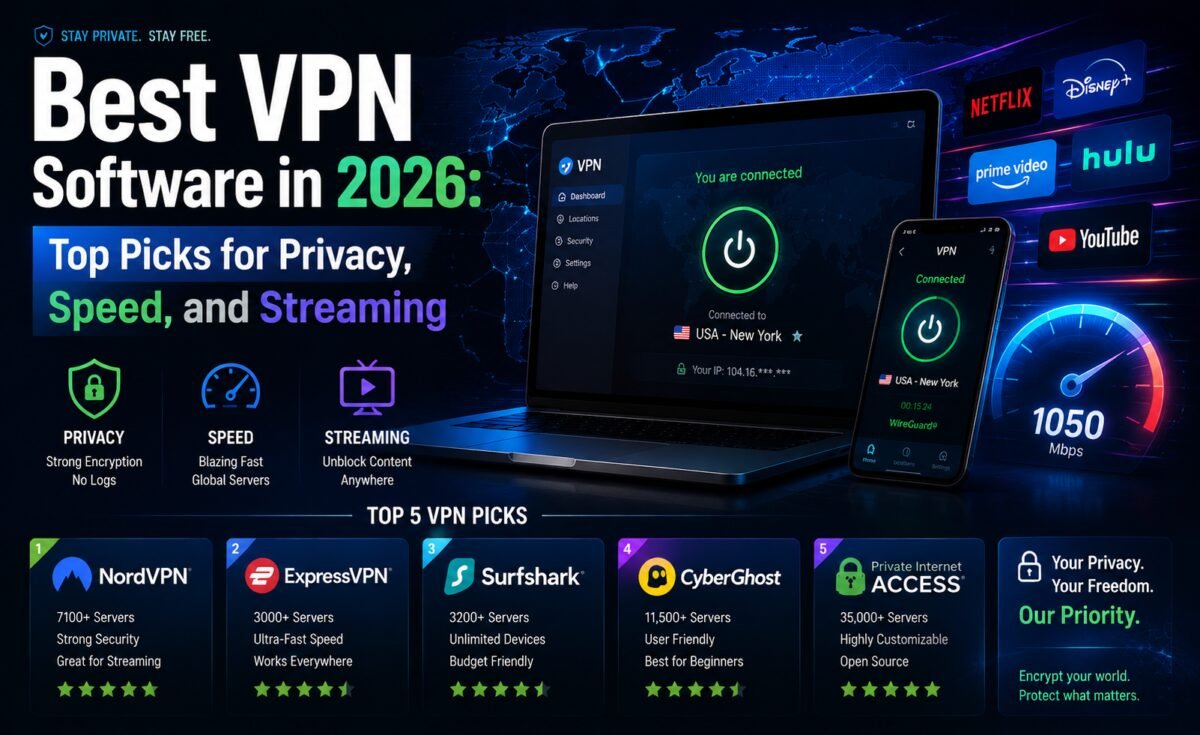
A VPN used to be a niche tool for the privacy-obsessed. Today, it’s practically a baseline utility — protecting your traffic on public Wi-Fi, unblocking geo-restricted content, and keeping your browsing history away from your internet provider. But not all VPNs are created equal, and the difference between a great one and a mediocre one shows up in dropped connections, throttled speeds, and privacy policies that don’t hold up to scrutiny. We tested the leading VPN providers for speed, security, and streaming reliability to bring you our top picks for 2026.
Editor’s Note from the Balumy Team: We ran each VPN through real-world speed tests, checked their independently audited no-logs policies, and tested streaming access across major platforms before ranking this list.
Quick Comparison: Best VPN Software of 2026
| Tool | Best For | Our Rating | Server Count |
|---|---|---|---|
| NordVPN | Overall best all-rounder | 4.8 / 5 | 6,000+ |
| ExpressVPN | Speed and reliability | 4.7 / 5 | 3,000+ |
| Surfshark | Best value / unlimited devices | 4.6 / 5 | 3,200+ |
| ProtonVPN | Privacy purists | 4.5 / 5 | 2,900+ |
| CyberGhost | Streaming-optimized servers | 4.3 / 5 | 10,000+ |
| Private Internet Access | Advanced customization | 4.2 / 5 | 35,000+ |
1. NordVPN — Best Overall
⭐⭐⭐⭐⭐ 4.8/5
NordVPN earns the top spot by delivering consistently strong performance across every category that matters: speed, security, streaming access, and ease of use. Its “Threat Protection” feature blocks malicious sites and trackers even when the VPN itself isn’t actively connected, adding a layer of everyday safety beyond simple traffic encryption.
The server network spans dozens of countries, and specialty servers (including obfuscated servers for restrictive regions and double-hop connections for extra anonymity) give power users options that most competitors don’t offer. Streaming support is excellent, reliably unblocking major platforms without the frequent disconnects that plague lesser VPNs.
- Pros: Excellent speeds, huge server network, strong streaming unblocking, independently audited no-logs policy
- Cons: Interface has a lot of settings that may overwhelm first-time users
2. ExpressVPN — Best for Speed and Reliability
⭐⭐⭐⭐⭐ 4.7/5
ExpressVPN has built its reputation on rock-solid consistency — connections rarely drop, and speeds remain stable even on longer sessions or distant server locations. The Lightway protocol, developed in-house, is noticeably faster to connect than older protocols while maintaining strong encryption standards.
The apps across every platform we tested (Windows, macOS, iOS, Android, and router-level installs) feel remarkably consistent in design, which matters for households running the VPN on multiple device types. It’s priced at the premium end of the category, but the reliability generally justifies the cost for users who depend on their VPN daily.
- Pros: Extremely reliable connections, fast proprietary protocol, consistent cross-platform apps
- Cons: Smaller server count than some competitors, premium pricing
3. Surfshark — Best Value
⭐⭐⭐⭐⭐ 4.6/5
Surfshark’s standout feature is unlimited simultaneous device connections on a single subscription — a genuine rarity in a category where most competitors cap you at five to ten devices. For larger households or users who want to protect every device they own without juggling multiple plans, this alone makes it worth a look.
Beyond the device allowance, Surfshark punches above its price point with solid speeds, a functional ad and malware blocker, and a “CleanWeb” feature that filters out intrusive trackers. It’s not quite as polished as NordVPN or ExpressVPN in raw performance, but the value proposition is hard to beat.
- Pros: Unlimited devices, strong value for price, built-in ad/tracker blocking
- Cons: Slightly slower peak speeds than top-tier competitors
4. ProtonVPN — Best for Privacy Purists
⭐⭐⭐⭐ 4.5/5
Built by the team behind ProtonMail, ProtonVPN puts privacy at the center of everything it does. It’s based in Switzerland, a jurisdiction with strong privacy laws, and publishes transparency reports detailing government data requests. The free tier — genuinely usable, not just a crippled trial — is one of the most generous in the industry.
Speeds on the free tier are limited to a handful of server locations, but paid plans unlock the full network with performance comparable to top competitors. For users whose primary concern is avoiding data collection rather than streaming or gaming, ProtonVPN’s privacy-first philosophy is difficult to match.
- Pros: Strong privacy jurisdiction, genuinely usable free tier, transparent reporting
- Cons: Smaller server network, free tier limited to fewer locations
5. CyberGhost — Best for Streaming
⭐⭐⭐⭐ 4.3/5
CyberGhost dedicates specific servers to individual streaming platforms, which simplifies the “which server do I pick” problem that trips up new VPN users on other services. Simply select the platform you want to access from a curated list, and CyberGhost connects you to a server optimized for that specific service.
The massive server count (among the largest in the industry) means you’re rarely far from a fast connection point, though speeds can vary more than premium competitors depending on server load. It’s a strong pick for casual users whose main use case is unblocking streaming content while traveling.
- Pros: Huge server network, streaming-optimized server selection, beginner-friendly interface
- Cons: Speed consistency varies more than top competitors
6. Private Internet Access — Best for Power Users
⭐⭐⭐⭐ 4.2/5
Private Internet Access (PIA) offers the deepest customization options of any VPN we tested — adjustable encryption levels, port forwarding, and granular kill-switch settings give advanced users precise control over how the app behaves. The server count is the largest on this list by a wide margin.
That depth of configuration comes at the cost of approachability; casual users may find the settings menu intimidating compared to the more streamlined interfaces of NordVPN or Surfshark. For torrenting, self-hosting, or networking enthusiasts who want fine-grained control, though, PIA remains a top choice.
- Pros: Massive server network, deep customization, strong torrenting support
- Cons: Interface less beginner-friendly, based in a less privacy-favorable jurisdiction than ProtonVPN
How We Tested Each VPN
Our team ran repeated speed tests across multiple server locations and times of day to account for network congestion, rather than relying on a single best-case benchmark. We also verified each provider’s no-logs claims against publicly available independent audit reports rather than taking marketing copy at face value.
Streaming reliability was tested against several major platforms over multiple days, since unblocking success can vary as streaming services update their VPN detection systems.
Buying Guide: What Matters Most in a VPN
- Audited no-logs policy: Look for providers who’ve undergone independent third-party audits, not just self-published claims.
- Kill switch: Ensures your real IP address is never exposed if the VPN connection drops unexpectedly.
- Server spread: A wider geographic spread means more reliable speeds and better access to region-locked content.
- Simultaneous connections: Check the device limit against how many devices your household actually needs to cover.
- Jurisdiction: Providers based outside data-sharing alliances generally offer stronger privacy guarantees.
Common Mistakes People Make When Choosing a VPN
The most frequent mistake is picking a VPN based purely on price without checking its logging policy. A cheap or free VPN with vague or unaudited privacy claims can end up doing the opposite of what you signed up for, potentially logging and monetizing the very browsing data you’re trying to protect. Always check whether a “no-logs” claim has been verified by an independent, published audit rather than taking a marketing page at face value.
Another common misstep is leaving the kill switch disabled. Without it, a brief VPN disconnection — which happens occasionally even with top providers — can silently expose your real IP address and unencrypted traffic until the connection reconnects. Every VPN on this list includes a kill switch; the mistake is simply forgetting to turn it on in settings.
Finally, some users assume a VPN alone makes them anonymous online. In reality, a VPN encrypts and reroutes your traffic, but logging into personal accounts (like email or social media) while connected still identifies you to those services. A VPN is one layer of a broader privacy strategy, not a complete solution on its own.
VPN Speed: What Actually Affects Performance
Several factors influence real-world VPN speed beyond the provider itself. Physical distance to the server matters most — connecting to a server on the other side of the world will always be slower than one in a nearby country, regardless of provider quality. Server load also plays a role; providers with larger server networks, like CyberGhost and Private Internet Access, tend to distribute user traffic more evenly, reducing congestion during peak hours.
The underlying protocol matters too. Newer protocols like WireGuard and proprietary variants (such as ExpressVPN’s Lightway or NordVPN’s NordLynx) are generally faster and more efficient than older standards like OpenVPN, while still maintaining strong security.
Frequently Asked Questions
Do VPNs slow down my internet connection?
Some speed reduction is normal due to encryption overhead, but top providers like NordVPN and ExpressVPN keep this impact minimal on typical broadband connections.
Is it legal to use a VPN?
VPNs are legal in most countries, though a small number of nations restrict or ban their use — check local regulations before traveling with one.
Can a free VPN be trusted?
Most free VPNs monetize through data collection or heavily limited bandwidth; ProtonVPN’s free tier is a rare exception with a genuinely privacy-respecting model.
Will a VPN let me access content from another country’s streaming library?
Often, yes — connecting to a server in a specific country routes your traffic through that location, though streaming services actively work to detect and block VPN traffic, so success can vary over time.
Can I use one VPN subscription on multiple devices?
Most providers allow five to ten simultaneous connections per account, and Surfshark notably offers unlimited devices, making it well-suited for larger households.
Final Verdict
NordVPN is our top overall pick thanks to its balance of speed, security, and streaming reliability. Users prioritizing raw connection stability should strongly consider ExpressVPN, while budget-conscious households with many devices will get excellent value from Surfshark. If privacy is your primary concern above all else, ProtonVPN‘s transparent, Switzerland-based approach is hard to beat. As always, take advantage of money-back guarantees to test real-world performance on your own network before committing long-term.



Leave a Reply