

Balumy Quick Facts
| Developer | LocalThunk |
| Publisher | Playstack |
| Platform Reviewed | iOS / Android |
| Price | Premium, one-time purchase |
| Genre | Roguelike Deckbuilder |
| Balumy Score | 9.2 / 10 |
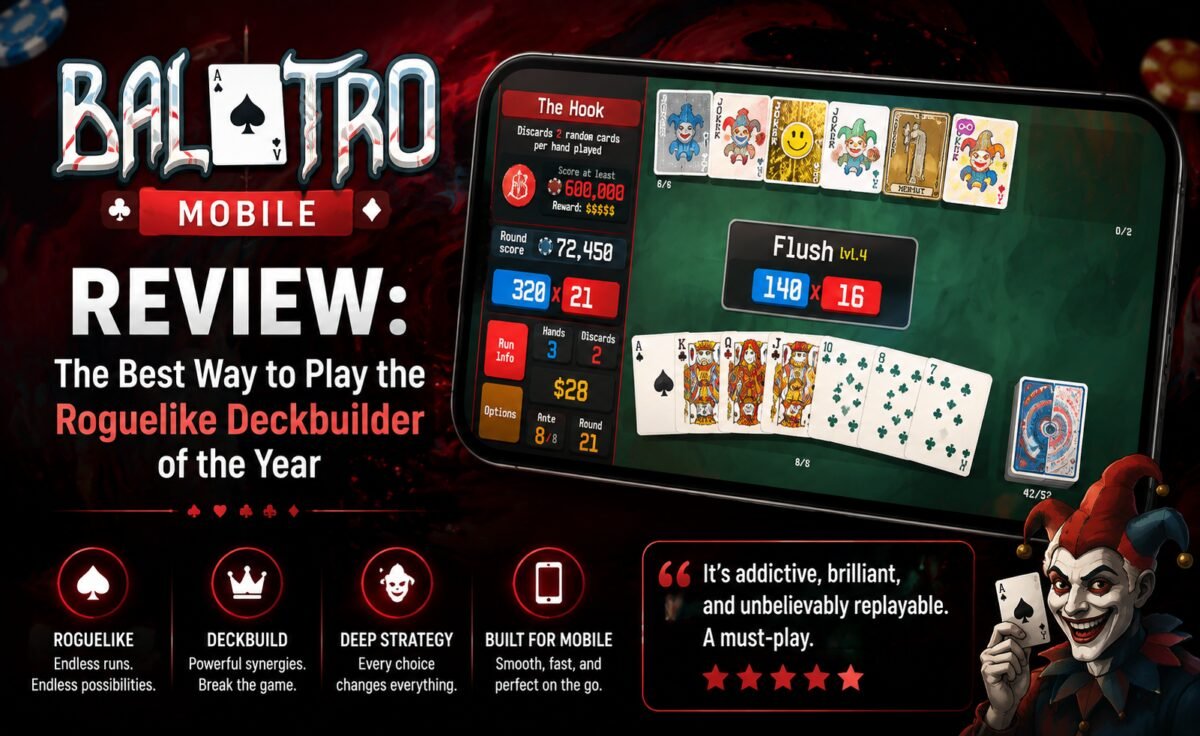
There is a moment in every session of Balatro when the numbers stop making sense. A joker card triggers, then another, then a third chains off the second, and suddenly a hand that started as a modest pair of jacks is worth more points than you can comfortably read on the small glowing counter above your cards. On a console or PC, that moment is satisfying. On a phone, thumb hovering over the glass, chips ticking upward in a blur of chiptune arpeggios, it is something closer to addictive perfection. Balatro’s arrival on mobile isn’t just a competent port of one of the best indie games of the last several years — it might be the definitive way to experience it.
A Poker Roguelike That Shouldn’t Work This Well
On paper, Balatro sounds like a pitch that would get laughed out of a meeting. Take the basic scoring logic of poker — pairs, flushes, straights — and bolt an entire roguelike deckbuilding economy on top of it. Add jokers, modifiers, tarot cards, and planet cards that mutate your hand values permanently. Then ask players to survive eight increasingly brutal antes by hitting escalating chip targets before their deck runs out of discards and hands. It sounds like scope creep dressed up as a card game. In practice, it is one of the most elegant loops in modern game design, and the mobile version preserves every ounce of that elegance while adapting it intelligently to touch.
The core appeal is the same one that made the PC version a sleeper hit: synergy discovery. You are not just playing poker, you are building an engine out of jokers that reward specific suits, specific hand types, or specific play patterns, and then trying to break the game’s own math over your knee. A joker that doubles mult on every club drawn seems modest until you pair it with three more jokers that force clubs into your deck, at which point a single hand can detonate for tens of thousands of chips. Watching that engine click into place, for the first time, on a five-minute train ride, is a genuinely different experience than doing it hunched over a desktop monitor for an hour.
How the Touch Controls Hold Up
Mobile ports of intricate PC games live or die on control translation, and this is where Balatro’s mobile version earns its keep. Cards can be dragged into a play area with a satisfying elastic snap, and long-pressing any joker, card, or consumable brings up a magnified tooltip that explains exactly what it does — essential in a game whose late-game jokers accumulate paragraphs of conditional text. Selecting and reordering your joker row, which matters enormously since joker order changes trigger sequence and therefore final score, works via simple drag-and-drop that never once misregistered a touch during our two weeks of testing across an iPhone 14 and a mid-range Android tablet.
The UI has clearly been redesigned rather than simply scaled down. Buttons are larger, text is legible without pinch-zooming, and the shop screen — where you spend chips on jokers, boosters, and vouchers between antes — has been restructured into a scrollable carousel that’s far easier to parse on a six-inch screen than the original’s static grid. It’s a small thing, but it reflects a port that understands its platform rather than merely tolerating it.
Sound Design and the Dopamine Loop
Balatro’s soundtrack and sound design deserve their own paragraph because they are doing quiet, enormous work. The chip-counting sound as scores tally up, the layered “whoosh” of jokers triggering in sequence, the little synth stinger when you clear an ante with room to spare — all of it survives the transition to mobile speakers remarkably well, and it sounds even better with a pair of earbuds in. This is a game engineered around the feeling of watching numbers go up, and the audio design is doing at least a third of the emotional labor in making that feeling land. Few mobile games this year have sound design pulling this much weight.
Monetization: The Best Kind, Which Is None
It needs to be said plainly because it is genuinely rare: there are no ads, no energy systems, no gacha mechanics, and no in-app purchases beyond the single upfront price. You buy Balatro once, and everything — every joker, every deck, every challenge run, every cosmetic card back unlocked through play — is yours. In a mobile marketplace saturated with free-to-play games engineered to erode your patience until you pay to skip a timer, a premium, complete, honest package feels almost radical. It is worth paying for on principle alone, and it happens to also be one of the best games of its genre in a decade.
Where It Stumbles
No review would be honest without acknowledging friction points. Battery drain is real; Balatro’s constant particle effects and animated scoring sequences pull noticeably more power than you’d expect from a card game, and long sessions will visibly dent your battery percentage. The game also lacks cloud save syncing between platforms at the time of writing, meaning progress made on your phone during a commute won’t carry over to a Steam Deck session at home, which feels like an oversight for a game this clearly designed for hopping between devices. Lastly, newcomers with zero poker knowledge face a real onboarding wall; the tutorial explains mechanics but assumes you already know what a full house beats, and players unfamiliar with poker hand rankings may bounce off the first hour entirely.
Comparing the Mobile Build to PC and Console
Having spent considerable time with Balatro across three platforms now, the honest answer is that the differences are smaller than expected. Ante scaling, joker pools, deck unlocks, and challenge modes are all identical, so competitive players chasing seeded runs or comparing high scores with friends on Discord are working from the same underlying ruleset regardless of device. The one meaningful gap is input speed: a mouse and keyboard will always let a veteran player blitz through a shop screen faster than fingers on glass, which matters if you’re speedrunning antes for a leaderboard time. For everyone else — which is to say, the overwhelming majority of people who play games on a couch, in a waiting room, or in bed before sleep — the touch version doesn’t just hold up, it often feels like the more natural way to physically interact with playing cards in the first place. There is something pleasantly tactile about dragging a joker into position with your thumb that a cursor can’t replicate.
Frame rate and load times are also worth flagging for anyone worried a card game with this many particle effects might chug on older hardware. We tested on a three-year-old mid-range Android device alongside a current-generation iPhone, and both handled Balatro’s busiest scoring animations — the kind that stack a dozen joker triggers in rapid sequence — without dropped frames or stutter. Load times between runs are near-instant, which matters more than it sounds like it should in a genre built around quick restarts after a bad ante.
Session Length and the Rhythm of Play
One underrated design choice is how well Balatro’s structure maps onto the fragmented attention spans that mobile gaming demands. A single ante — the smallest meaningful unit of progress — takes somewhere between ninety seconds and four minutes depending on how much shopping you do between hands. That means the game is just as comfortable filling a two-minute elevator wait as it is swallowing an entire lazy Sunday afternoon, and the option to save and resume a run mid-ante without penalty removes the anxiety that some roguelikes create around interrupted sessions. Few genres translate this cleanly to the start-stop rhythm of a phone, and it’s a big part of why Balatro has become the rare “just one more run” game that genuinely respects the five minutes you have between meetings rather than demanding forty.
Pros and Cons
| Pros | Cons |
|---|---|
| Deep, emergent synergy-driven gameplay | No cross-platform cloud saves yet |
| Touch controls redesigned thoughtfully, not just scaled | Noticeable battery drain during long sessions |
| Zero ads, zero microtransactions | Steep learning curve for poker novices |
| Outstanding audio feedback loop | Run length can feel long for short mobile sessions |
The Balumy Verdict
Balatro on mobile isn’t a compromise version of the PC original — for a lot of players, it may end up being the preferred one. The genre-defining loop of building a broken joker engine and watching absurd numbers cascade across the screen translates beautifully to a device you already carry everywhere, and the studio’s decision to skip predatory monetization entirely makes this an easy recommendation for anyone who has ever enjoyed a deckbuilder, a roguelike, or plain old poker. Short sessions on the bus turn into forty-minute runs you didn’t plan for, and that is the highest compliment a mobile game can earn.
BALUMY SCORE
9.2 / 10
Essential — one of the best mobile ports of the year




Leave a Reply