

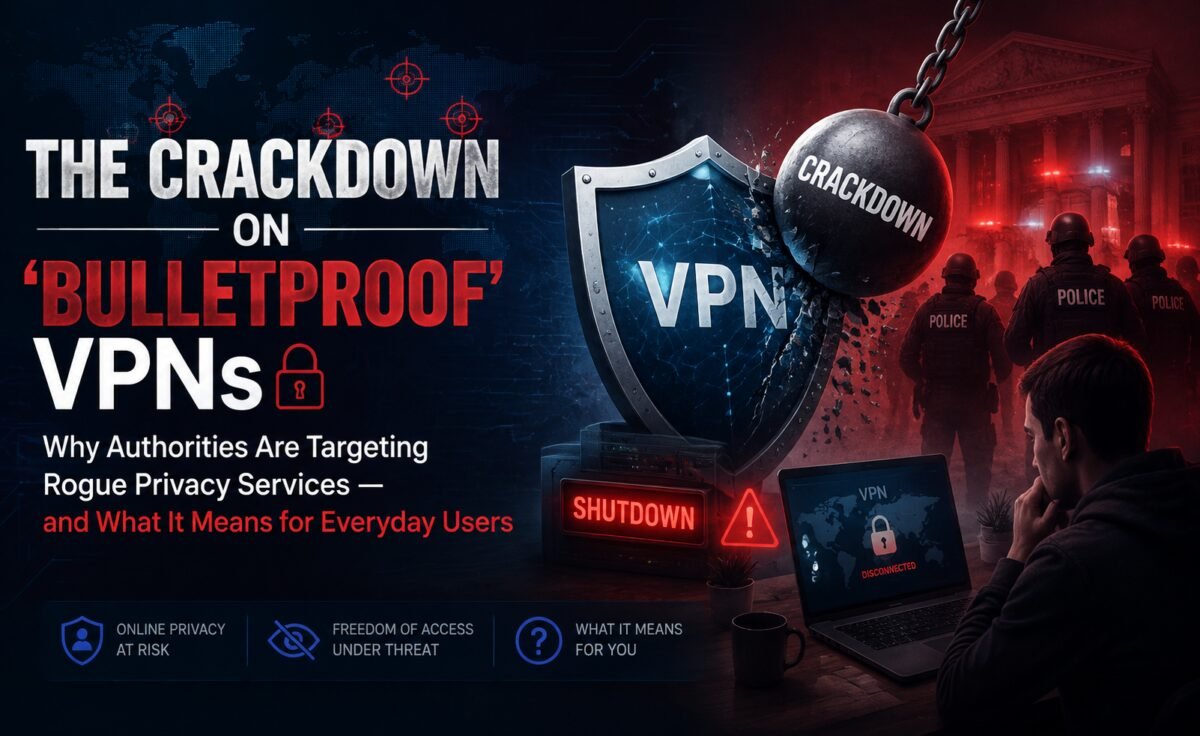
A quieter but equally consequential story has been unfolding alongside the more visible headlines about mainstream VPN growth: a coordinated, intensifying crackdown by law enforcement and government agencies on so-called “bulletproof” VPN services — infrastructure providers that market themselves not to privacy-conscious consumers, but to criminal operators seeking to obscure ransomware campaigns, data theft, and other illicit activity.
What Makes a VPN “Bulletproof”
The term “bulletproof hosting” has existed in cybersecurity circles for years, referring to infrastructure providers — hosting companies, proxy networks, and VPN services — that explicitly advertise their unwillingness to cooperate with law enforcement requests, regardless of the activity taking place on their networks. Unlike legitimate consumer VPNs, which generally maintain policies for responding to valid legal process while still protecting ordinary users’ privacy, bulletproof services are built around a business model that caters specifically to actors who need to operate outside the reach of international law enforcement entirely.
These services have historically played a quiet but significant role in the broader cybercrime ecosystem, providing the infrastructure layer that lets ransomware groups, scanning operations, and denial-of-service campaigns mask their true origin. A ransomware attack that appears to originate from an anonymous VPN exit node, rather than a traceable server controlled by the attacker, is considerably harder for investigators to unwind.
A Coordinated, Cross-Border Response
What has changed recently is the scale and coordination of the response. Rather than isolated actions by individual national agencies, recent enforcement efforts have involved joint operations spanning multiple countries, combining law enforcement raids, infrastructure seizures, and financial sanctions targeting the operators and, in some cases, the cryptocurrency wallets used to pay for these services.
One recent action illustrates the pattern clearly: a VPN service that had operated since the mid-2010s, explicitly marketing a policy of not logging user identities or activity and refusing law enforcement cooperation, was dismantled through a joint operation involving authorities across Europe and North America. According to officials involved, the service had been used by multiple ransomware groups to obscure the origin of attacks against companies and institutions, manage stolen data, and coordinate malware deployment. In parallel, financial authorities imposed formal sanctions on the operators, a step that goes beyond simply seizing servers and instead attempts to cut off the financial infrastructure that allowed the service to keep operating.
This dual approach — simultaneous technical takedown and financial sanction — reflects a broader strategic shift among Western law enforcement and regulatory bodies. Rather than treating infrastructure seizures as a one-off disruption that criminal operators can simply route around by standing up new servers elsewhere, sanctions aim to make the underlying business model itself financially untenable by cutting off payment processing and freezing associated assets.
The Broader Cybercrime Context
These actions against rogue VPN infrastructure have not happened in isolation. They form part of a wider, coordinated push against the networks of tools and services that support ransomware and state-linked cyber operations. Alongside VPN-focused enforcement, authorities in multiple countries have simultaneously targeted malware distribution networks, cryptocurrency mixing services used to launder ransom payments, and specific threat actor groups linked to critical infrastructure intrusions.
Security researchers tracking these campaigns have noted overlapping tactics involving the exploitation of known, sometimes years-old vulnerabilities in networking equipment — flaws that, despite having patches available for a long time, remain unaddressed on a surprising number of poorly maintained devices. Threat actor groups linked to state-sponsored espionage have been observed using these vulnerabilities to gain initial footholds in target networks before leveraging bulletproof VPN infrastructure to mask follow-on activity, illustrating how consumer-facing VPN crackdowns connect to much larger national security concerns than they might initially appear to.
Why This Matters for Legitimate VPN Users
It is worth being clear about an important distinction: the services being targeted in these enforcement actions are fundamentally different from the mainstream consumer VPN products used by hundreds of millions of ordinary people for everyday privacy, security on public Wi-Fi, or accessing geo-restricted content. Reputable consumer VPN providers generally maintain transparent policies, respond to valid legal process in their operating jurisdictions, undergo independent audits, and explicitly prohibit illegal activity in their terms of service.
That said, these crackdowns have real implications for how the entire VPN industry is perceived and regulated. Every high-profile enforcement action against a “no-logs, no-questions-asked” VPN used by ransomware operators feeds into broader political conversations — some of them already underway in the context of age verification laws discussed elsewhere in current VPN news coverage — about whether VPN providers as a category should face tighter oversight, mandatory data retention requirements, or stricter licensing.
Legitimate providers are increasingly aware of this reputational risk and have responded by leaning further into transparency: publishing regular transparency reports detailing law enforcement requests received and how they were handled, commissioning independent audits of their no-logs claims, and being explicit in marketing materials about the distinction between protecting user privacy and facilitating illegal activity.
How Investigators Are Adapting
Beyond the headline-grabbing takedowns, there has also been a quieter evolution in investigative technique. Rather than relying solely on traditional digital forensics, agencies have increasingly incorporated financial intelligence — tracing cryptocurrency payments used to purchase bulletproof VPN subscriptions — as a parallel investigative track alongside network-level analysis. This financial trail has, in several cases, proven more durable than the technical infrastructure itself, since operators can rotate servers far more easily than they can fully obscure the payment relationships that fund their operations.
International cooperation has also matured considerably. Where cross-border cybercrime investigations once moved slowly due to jurisdictional complexity and inconsistent legal frameworks, recent joint operations have demonstrated a faster, more synchronized approach, with multiple countries executing coordinated actions — arrests, server seizures, and sanctions announcements — within the same operational window rather than staggered over months.
What to Watch Going Forward
Expect this trend to continue and likely intensify. As ransomware remains one of the most financially damaging categories of cybercrime globally, the infrastructure that enables it — including bulletproof VPN and hosting services — will remain a priority target for law enforcement and financial regulators alike. For the broader VPN industry, that means continued pressure to visibly differentiate legitimate, privacy-respecting services from the small subset of providers whose entire business model is built around enabling anonymity for criminal activity.
For everyday users, the practical takeaway is reassuring rather than alarming: these enforcement actions are aimed squarely at services designed from the ground up to serve criminal actors, not at the mainstream consumer VPNs relied on for legitimate privacy and security. If anything, the increasing scrutiny on bad actors in the space is likely to push reputable providers toward even greater transparency — a welcome development for anyone trying to separate genuine privacy protection from marketing noise in an increasingly crowded market.
How to Tell a Legitimate VPN From a Red Flag
For users trying to evaluate a VPN provider in light of this enforcement climate, a few practical signals tend to distinguish reputable services from the kind of infrastructure that ends up in law enforcement crosshairs. Legitimate providers are typically transparent about their corporate structure and jurisdiction, publish clear terms of service that explicitly prohibit illegal activity, and are willing to describe — in general terms — how they respond to valid legal process, rather than marketing an absolute, unconditional refusal to ever cooperate with any investigation under any circumstances.
- Published transparency reports detailing the volume and nature of law enforcement requests received, even if the substantive answer to most of them is “we had no data to provide.”
- Independent no-logs audits conducted by recognized security firms, with methodology and findings summarized publicly rather than simply asserted in marketing copy.
- A identifiable corporate entity and jurisdiction, rather than deliberately obscured ownership designed to frustrate any attempt at accountability.
- Clear terms of service that explicitly prohibit using the service to facilitate cybercrime, rather than services that market total anonymity as a selling point aimed specifically at illicit use cases.
None of these signals alone guarantees a provider’s trustworthiness, but taken together they paint a fairly reliable picture of a company built to serve legitimate privacy needs rather than one built specifically to shield criminal activity from accountability — the core distinction regulators are increasingly drawing as enforcement in this space intensifies.
The Road Ahead for VPN Regulation
These enforcement actions are also likely to influence the broader, ongoing conversation about how VPN services should be regulated as an industry. Policymakers weighing new rules — whether focused on age verification, data retention, or general licensing requirements for VPN providers — frequently point to bulletproof VPN cases as evidence that the category as a whole needs tighter oversight, even when the vast majority of consumer VPN usage has nothing to do with criminal activity.
Industry trade groups and reputable providers have pushed back against overly broad regulatory proposals on the grounds that they would primarily burden legitimate privacy-focused services and their law-abiding users, while doing comparatively little to stop determined criminal operators who can simply relocate infrastructure to less cooperative jurisdictions. That tension — between targeted enforcement against genuinely bad actors and broader regulatory measures that risk sweeping in legitimate privacy tools — is likely to remain one of the central fault lines in VPN policy discussions for the foreseeable future, and is worth watching closely alongside the enforcement actions themselves.




Leave a Reply