

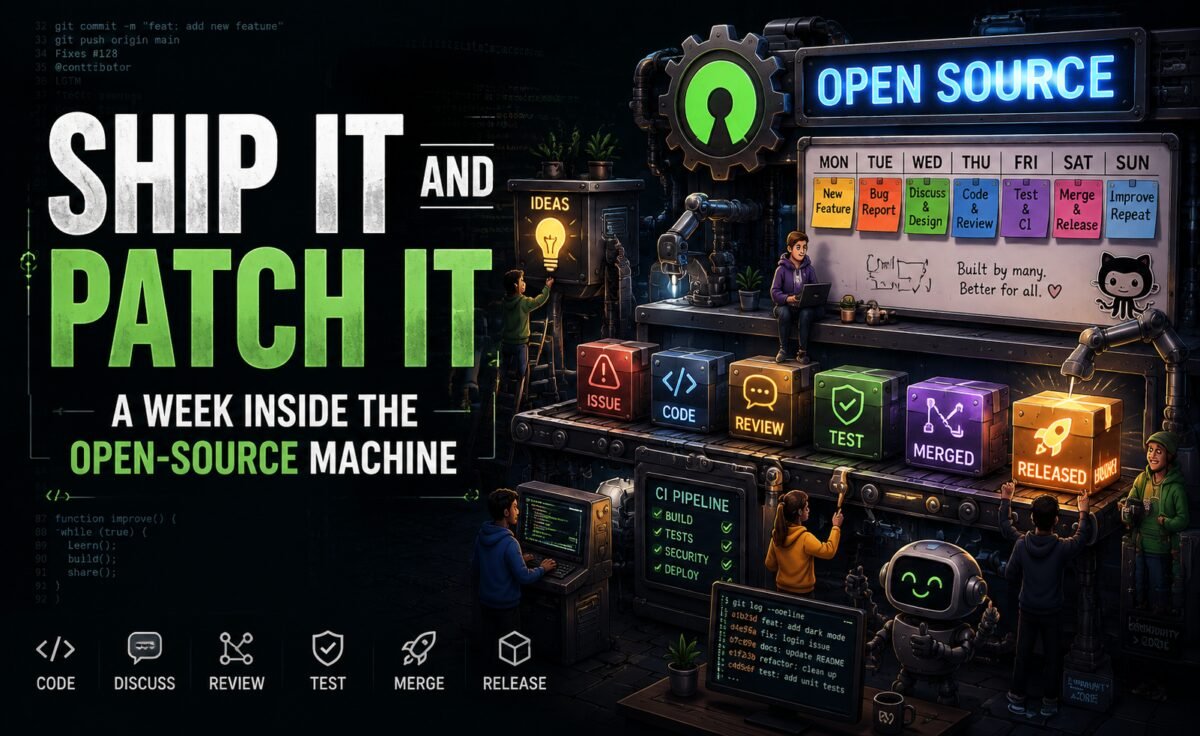
Open source software doesn’t announce itself with keynote presentations or stock-market reactions. It ships, quietly and constantly, in weekly waves of point releases, roundup posts, and mailing-list threads. The final week of July 2026 was a useful microcosm of that world — equal parts steady progress and long-overdue reckoning.
Firefox Gets Its Extended Support Refresh
Mozilla shipped Firefox 153 as its new Extended Support Release, the version enterprises and cautious users lean on for its longer, more predictable update cycle, alongside a parallel release of Thunderbird 153 for the email client side of the Mozilla project. Neither release is flashy on its own, but Mozilla used the accompanying documentation to preview what’s coming in the standard-channel Firefox 154, and those previewed features say something about where browser development is heading in 2026: a “Manage AI” quick action embedded directly in the address bar that opens straight to the browser’s AI settings section, the ability to clear and refresh cached favicons during a hard page reload, and support for highlighting selected text inside PDFs the same way users already can on a normal web page.
Separately, one of Firefox’s most popular privacy extensions is reportedly being folded directly into the browser as a native feature rather than remaining a separate add-on — part of a broader, ongoing pattern of browser vendors absorbing the most successful pieces of their extension ecosystems into the core product.
The Kernel Keeps Moving
On the infrastructure side, Linus Torvalds announced the second release candidate for Linux kernel 7.2 in late July, keeping the kernel’s rolling release cadence on schedule. Around the same milestone, NetworkManager 1.58 landed with a new round of feature additions and stability improvements, and VirtualBox 7.2.14 shipped with initial support for the still-in-development kernel 7.2 branch, alongside improved compatibility with updated RHEL 9.8 and 9.9 kernel builds — the kind of unglamorous plumbing work that keeps the wider Linux ecosystem functioning smoothly underneath the more visible desktop releases.
On the desktop side specifically, System76’s Rust-based COSMIC desktop environment reached version 1.4, adding a new default sound theme and expanding its system monitor with application-level controls and GPU statistics — continuing a rapid release cadence that has made COSMIC one of the more closely watched new desktop projects in the Linux world since its debut. Ubuntu Touch also received a significant OTA 2.0 update, bringing a browser upgrade and new printing support to Canonical’s mobile-focused Linux project, while the anonymity-focused Tails operating system reached version 7.10 with improved protections against data loss.
Two Very Old Bugs, Freshly Discovered
The week’s more sobering story concerned two serious Linux kernel privilege-escalation vulnerabilities, both of which had sat undetected in the kernel for well over a decade before being surfaced by modern tooling. The first, dubbed GhostLock and tracked as CVE-2026-43499, is a use-after-free bug that has existed in the kernel since 2011. It was discovered not by a human researcher combing through source code line by line, but by Nebula Security’s AI-driven analysis tool, VEGA, which was able to construct a working exploit that achieved 97 percent reliability in testing and was capable of escaping standard container isolation entirely. The bug itself was fixed back in April 2026, but patch adoption has lagged badly behind disclosure: as of early July, several current Ubuntu long-term-support releases were still listed as vulnerable, months after a fix was technically available.
The second, Januscape, tracked as CVE-2026-53359, affects the KVM hypervisor’s shadow memory management unit emulation on x86 processors and is sixteen years old. It was identified by independent researcher Hyunwoo Kim and allows a guest virtual machine with root-level privileges inside its own sandbox to potentially compromise the host system it’s running on — a particularly concerning flaw given how widely KVM underpins cloud infrastructure across the industry.
Both discoveries fit a pattern security researchers have flagged repeatedly through 2026: as AI-assisted code analysis tools mature, they are increasingly capable of surfacing genuinely old, deeply buried vulnerabilities that manual code review missed for years — forcing a wider reckoning with exactly how much unaddressed security debt sits inside software the entire industry has quietly trusted for over a decade.
Microsoft, of All Companies, Doubles Down on Linux
In a smaller but symbolically notable development, Microsoft continued expanding Azure Linux, its own in-house Linux distribution, with version 4.0 marking a deliberate shift from a narrow, container-focused role toward positioning as a genuine general-purpose server operating system. It’s a reminder of just how thoroughly Microsoft’s relationship with Linux has been transformed over the past decade, from open hostility to treating it as core infrastructure for its own cloud platform.
Governance Fights Over AI-Written Code
Not every story from the week was about code itself — some were about who, or what, is allowed to write it. Codeberg, a community-run Git hosting platform positioned as an ethical alternative to GitHub, announced it would ban projects found to be mostly written by generative AI tools, a policy move that puts it at the center of an increasingly heated debate within open-source communities about the acceptability of AI-generated contributions. Debian’s own developer community has reportedly been holding a parallel debate over whether to formally restrict AI-assisted contributions to the distribution, while the loss of a longtime GNOME security maintainer — who has single-handedly run the project’s security tracking process since 2020 and is departing at the end of the year — has renewed broader concern about how thinly staffed the security functions underpinning major open-source projects genuinely are, even as those projects sit at the foundation of enormous swaths of commercial and government software.
One Small Piece of Housekeeping, Two Decades in the Making
Finally, a small but genuinely pleasant piece of news for a corner of the open-source multimedia world: the last active patent covering the MPEG-4 Visual video codec, held in Brazil, formally expired on July 19, 2026. That single expiration frees the long-running open-source codecs DivX and Xvid from patent licensing obligations worldwide for the first time since their creation, closing out a chapter of video-codec history that stretches back to the early 2000s.
The Takeaway
No single item from this particular week will make front-page technology news on its own. Taken together, though, they capture what makes the open-source ecosystem simultaneously so resilient and so quietly fragile: a steady, almost mechanical cadence of releases and improvements, running directly alongside the slow, uneven process of discovering and fixing mistakes that have sat unnoticed for years, all of it maintained by a community that is only now beginning to figure out what role AI tools should play — both in finding the next decade-old bug, and in deciding who gets credit for writing the code in the first place.
The Patch-Adoption Gap Nobody Wants to Talk About
The most quietly alarming detail from the week’s kernel news isn’t that GhostLock existed for fifteen years without being caught — long-lived bugs are, unfortunately, a fact of life in any codebase of the Linux kernel’s size and age. It’s that a fix has been publicly available since April 2026, and as of early July, multiple current Ubuntu long-term-support releases were still shipping without it. That gap between “patch exists” and “patch is actually deployed on production systems” is arguably a bigger practical security problem than the discovery timeline itself. Distribution maintainers, cloud providers, and individual system administrators all sit somewhere along that adoption chain, and a vulnerability that escapes container isolation with 97 percent reliability doesn’t need to stay theoretical for very long once its details are public and a meaningful share of real-world deployments remain unpatched months after a fix ships.
It’s a pattern worth watching closely as AI-assisted vulnerability discovery tools like Nebula Security’s VEGA become more common across the industry. If the rate at which these tools surface genuinely old, serious vulnerabilities keeps climbing — and there’s little reason from 2026’s data so far to expect it to slow down — the bottleneck in open-source security is likely to shift decisively away from discovery and toward the comparatively unglamorous, chronically underfunded work of getting fixes actually deployed across the enormous, decentralized footprint of systems that depend on the Linux kernel every day.
Why the Small Stories Still Matter
It’s tempting to treat items like a new default sound theme in COSMIC 1.4, a browser upgrade for Ubuntu Touch, or the expiration of a two-decade-old video codec patent as filler between the genuinely consequential stories. But the cumulative effect of hundreds of small, unglamorous releases like these, shipped week after week by volunteer maintainers and small commercial teams alike, is exactly what has kept the open-source ecosystem functional and improving for over three decades, long before any of this year’s AI tooling entered the picture. The MPEG-4 Visual patent expiration in particular is a reminder that some of open source’s biggest practical wins arrive not through a dramatic announcement, but through the simple, quiet passage of time — a patent clock running out, freeing tools that millions of people have already been using for years to finally operate with full legal clarity everywhere in the world at once.




Leave a Reply