

Quick take: Jasper is the AI writing platform built specifically for marketing teams — brand voice training, campaign templates, and collaboration features included. It’s powerful and polished, but it’s also priced well above general-purpose chatbots, so the value equation depends heavily on how much marketing content you actually produce.
What Is Jasper?
Jasper (formerly Jasper.ai, and before that Conversion.ai) is an AI content platform aimed squarely at marketing teams, agencies, and brands that need to produce large volumes of on-brand copy — blog posts, ad copy, email campaigns, social content — without every piece sounding like it came from a generic chatbot.
Unlike ChatGPT or Claude, which are general-purpose assistants you configure yourself, Jasper is built around the assumption that you’re producing marketing content at scale and need brand consistency, team collaboration, and campaign-level organization baked in from day one.
Key Features
1. Brand Voice Training
You can feed Jasper existing content — website copy, past blog posts, style guides — and it builds a brand voice profile that gets applied automatically to new content. This is genuinely one of Jasper’s strongest features; once trained, output stays noticeably more consistent with your brand than manually prompting a general chatbot every time.
2. Campaign and Brief Tools
Jasper lets you build content briefs and generate multiple assets — a blog post, matching social captions, an email teaser — from a single campaign brief, which saves real time for teams juggling multi-channel launches.
3. Templates Library
A large library of pre-built templates covers everything from Facebook ad copy to product descriptions to AIDA-framework landing pages. For marketers who don’t want to write prompts from scratch, this lowers the learning curve significantly.
4. SEO Integration
Jasper integrates with SEO tools to surface target keywords and content briefs directly inside the writing workflow, which is a meaningful convenience for content teams optimizing for search.
5. Team Collaboration
Shared brand voices, shared templates, folder organization, and approval workflows make Jasper noticeably more built for teams than solo-focused chatbots.
Pricing
Jasper is priced per seat and sits meaningfully higher than general-purpose chatbot subscriptions, with plans scaling up based on team size and features like brand voice and campaign tools. There’s no permanently free tier — usually just a limited trial period — which makes it a harder sell for solo bloggers or hobbyists, but a more reasonable proposition for agencies and marketing departments where the time saved across a team offsets the higher per-seat cost.
Writing Quality
Jasper’s raw writing quality is solid, generally on par with other leading models it’s built on top of, but the real value isn’t in producing a single amazing sentence — it’s in producing consistently on-brand content across dozens of pieces without manual re-explaining every time. Where Jasper occasionally underwhelms is nuanced, personality-driven long-form writing; it’s optimized for structured, conversion-focused marketing copy rather than essayistic or literary prose, and it shows.
Templates help less-experienced writers get to a usable draft fast, but power users sometimes find the templated approach slightly constraining compared to the free-form flexibility of a general chatbot.
Best Use Cases
- Marketing teams producing high volumes of on-brand content across channels
- Agencies managing multiple client brand voices simultaneously
- E-commerce brands needing consistent product copy at scale
- Content teams wanting SEO briefs integrated directly into the writing process
Pros and Cons
| Pros | Cons |
|---|---|
| Brand voice training keeps output consistently on-brand | Significantly more expensive than general chatbot subscriptions |
| Strong template library speeds up common marketing tasks | Less flexible for long-form, personality-driven writing |
| Built-in SEO workflow integration | No permanently free tier |
| Genuinely useful team collaboration features | Learning the platform takes longer than a plain chatbot |
| Campaign tools save time on multi-asset launches | Overkill for solo writers or infrequent use |
How It Compares
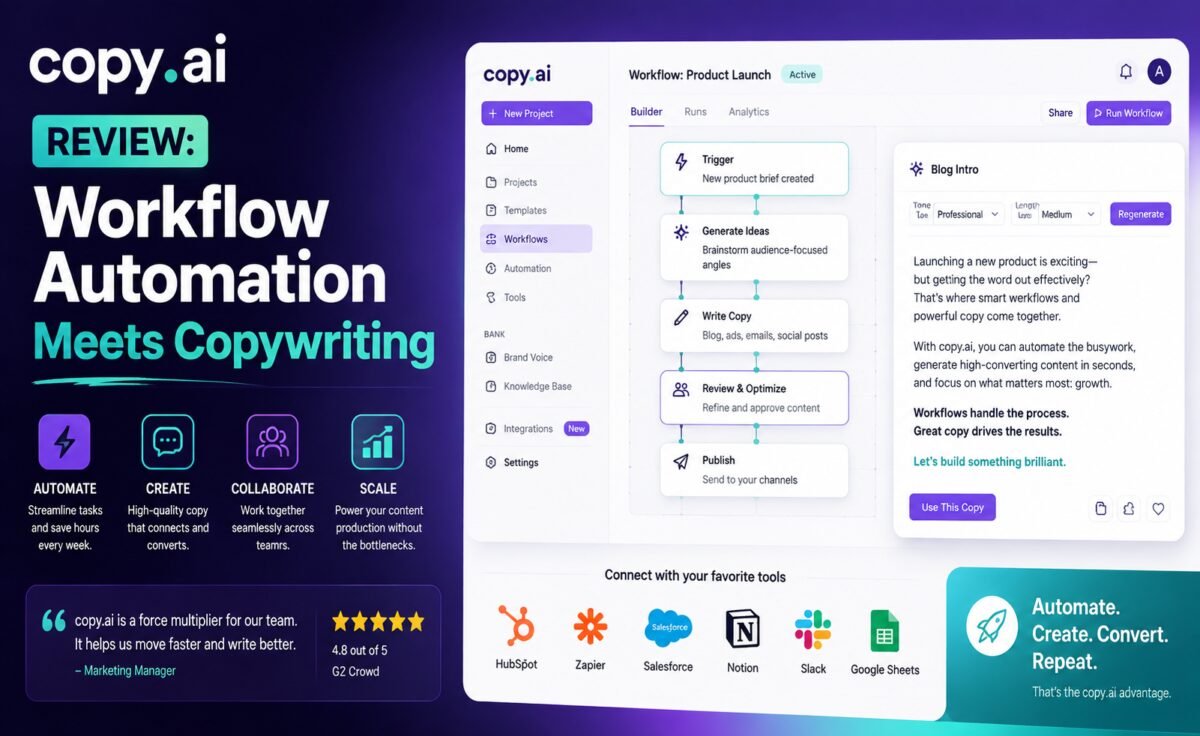
Against ChatGPT and Claude, Jasper trades general-purpose flexibility for marketing-specific structure — you’re paying a premium for brand voice consistency, templates, and team workflows that you’d otherwise have to build manually. Against Copy.ai, the two are close competitors covering similar ground, with Jasper generally seen as the more polished, enterprise-ready option and Copy.ai often positioned as the more affordable, workflow-automation-focused alternative.
A Week With Jasper: Real-World Notes
To test Jasper the way a small marketing team actually would, we set up a Brand Voice profile using an existing website’s homepage and about-page copy, then used it to produce a full campaign: a blog post, three ad copy variations, two email subject lines, and a set of matching social captions, all built from a single campaign brief.
The brand voice training was where Jasper distinguished itself most clearly. After the initial setup — which took about fifteen minutes, mostly spent selecting the right reference pages — new content consistently matched the source material’s tone without further prompting, including some fairly specific phrasing quirks that a general chatbot would have needed to be reminded of repeatedly. Building the multi-asset campaign from one brief was also a genuine time-saver; instead of separately prompting for a blog post, then ads, then social captions, generating a coordinated set of assets took a fraction of the time it would have taken switching between manual prompts in a general chatbot.
The templates were a mixed experience. For structured formats like product descriptions and short ad copy, they worked well out of the box. For the blog post specifically, the template-driven structure occasionally felt slightly formulaic — competent, on-brand, but with less of the natural variation you’d get prompting a general-purpose model freely. SEO integration was a genuine convenience, surfacing a workable keyword list and content brief directly in the same workflow rather than requiring a separate research step.
By the end of the week, the case for Jasper felt clear: for a single piece of content, it’s not obviously better than a well-configured general chatbot. For a full campaign produced by more than one person, the time saved through brand voice consistency and multi-asset generation from one brief adds up quickly.
Tips to Get Better Results
- Invest real time in Brand Voice setup. Feed it your best, most representative existing copy — homepage, top-performing ads — rather than a random sample, since the training quality directly determines output consistency.
- Use campaign briefs for multi-asset work. Generating a blog post, ads, and social captions from one brief is faster and more coherent than prompting each asset separately.
- Don’t skip the human edit on long-form content. Templates are strongest for short, structured copy; blog posts and articles generally still benefit from a manual pass for flow and variation.
- Assign brand voices per client if you’re an agency. Keeping separate, clearly labeled voice profiles prevents cross-contamination between accounts.
Who Should Skip This Tool
Solo bloggers and infrequent writers will likely find the per-seat pricing hard to justify against a general chatbot subscription that costs meaningfully less. And if your priority is long-form editorial or narrative writing rather than structured marketing assets, Claude’s more flexible, less templated approach to prose will probably serve you better.
Our Rating
| Category | Score |
|---|---|
| Writing Quality | 4.1 / 5 |
| Features | 4.6 / 5 |
| Ease of Use | 4.0 / 5 |
| Value for Money | 3.7 / 5 |
| Overall | 4.1 / 5 |
Support, Onboarding, and Community
Jasper’s onboarding is noticeably more guided than a plain chatbot, with walkthroughs for setting up Brand Voice and building your first campaign — a reasonable acknowledgment that the platform has more moving parts to learn. Support channels include live chat and a help center with searchable articles, and response times have generally been prompt in our experience, which fits the higher price point and business-focused audience.
There’s also an active user community and a library of use-case guides aimed specifically at marketers, which is a genuine advantage over more general tools when you’re trying to figure out the best way to structure a specific type of campaign. For teams evaluating whether the higher cost is justified, the more hands-on onboarding and support experience is part of what you’re paying for.
Frequently Asked Questions
Is Jasper worth it for a solo blogger?
Probably not — the per-seat pricing and team-oriented features are built for organizations producing marketing content at volume. A general chatbot will likely serve a solo blogger better and cheaper.
Does Jasper replace a copywriter?
It speeds up drafting and keeps output on-brand, but most teams still use a human editor for final polish, strategic messaging, and quality control.
Can I cancel after the trial?
Yes, Jasper’s trial converts to a paid plan automatically unless canceled beforehand, so it’s worth setting a reminder if you’re just testing it out.
Final Verdict
Jasper is a genuinely strong tool for what it’s built for: marketing teams that need consistent, on-brand content across many pieces and channels, with collaboration baked in. It’s not the most cost-effective choice for solo writers or general-purpose use, but for its target audience, the specialization pays for itself. If you’re evaluating it, the best test is a short trial run on one real campaign — brand voice setup, a full asset bundle, and a team review — rather than judging it on a single isolated piece of copy, since the platform’s real advantages only become obvious at that scale.



Leave a Reply