
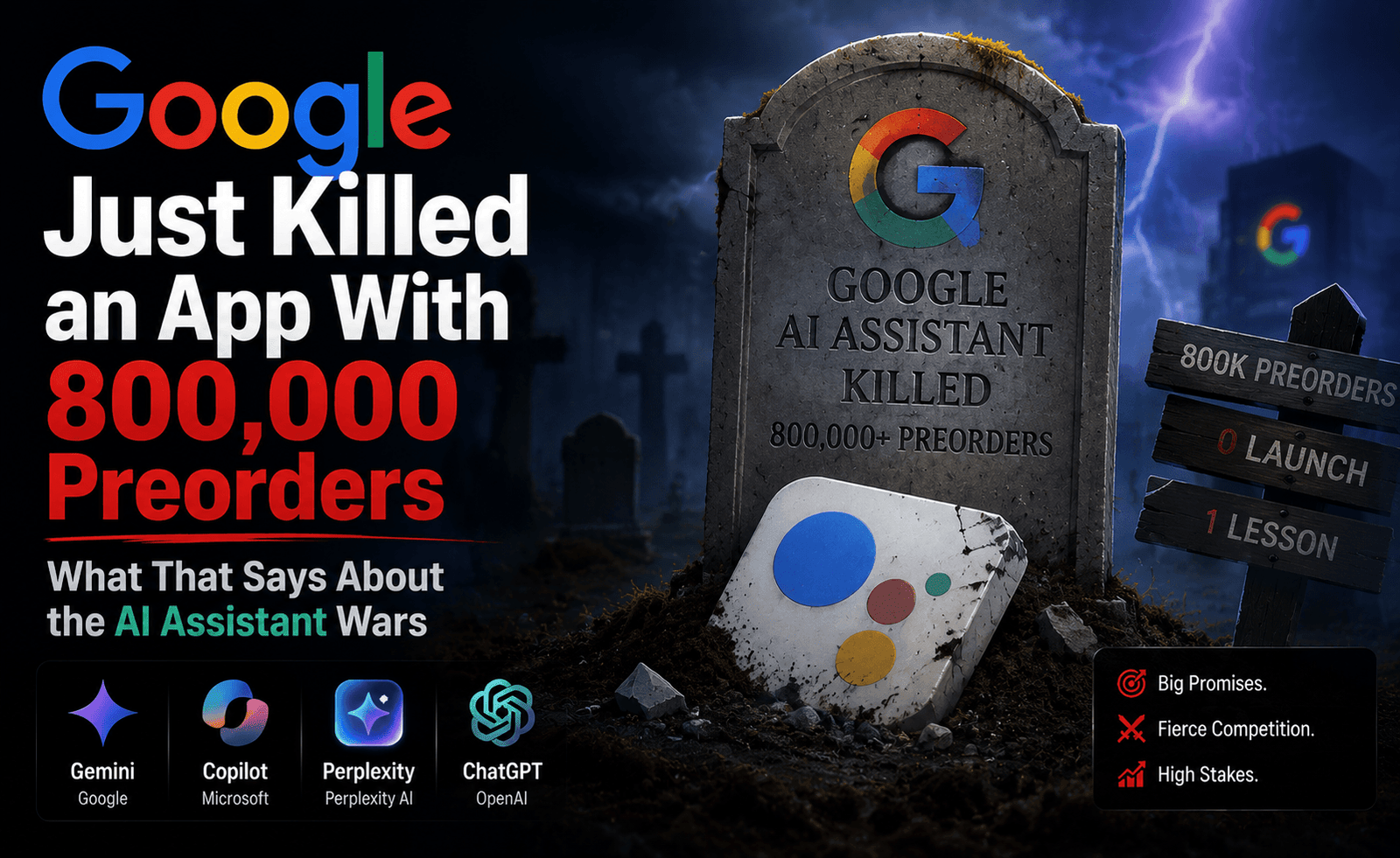
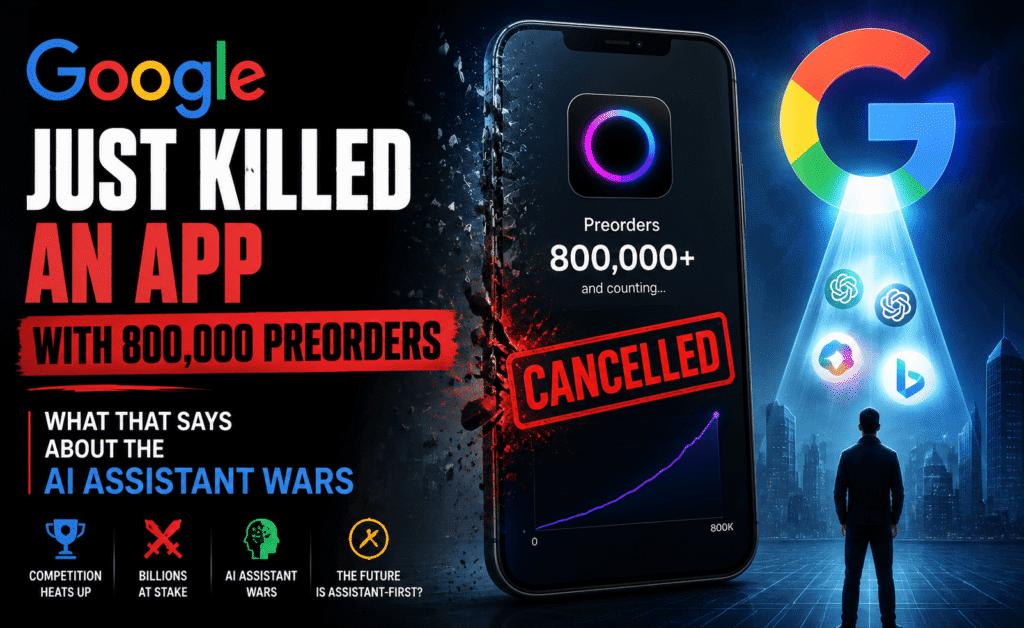
Somewhere inside Google, a mobile app with more than 800,000 preorders — built and promoted since the company’s I/O developer conference in 2026 — was quietly shelved rather than shipped. Google confirmed it has canceled the planned standalone AI Studio mobile app for both iOS and Android, choosing instead to fold the app-creation features it was built around directly into Gemini. On paper, that sounds like a minor internal reorganization. In practice, it’s one of the more revealing product decisions to come out of any major AI lab this year, precisely because it runs against the instinct that drives almost every other announcement in this space: more surface area, more dedicated apps, more places for users to encounter a company’s AI.
What AI Studio Was Supposed to Be
Google’s AI Studio has functioned, for the past couple of years, primarily as a developer-facing tool — a place to prototype with Gemini models, test prompts, and build small AI-powered applications without needing to stand up a full development environment. The standalone mobile app, previewed at I/O 2026, was meant to extend that app-creation capability to a broader, more consumer-facing audience directly on their phones: the pitch being that anyone, not just developers comfortable in a browser-based console, could sketch out and generate a working AI app from a mobile device.
The preorder numbers suggest the pitch landed. Drawing more than 800,000 preorders for an app that had not yet shipped is a meaningful signal of demand by almost any consumer software standard — enough that canceling it outright, rather than simply delaying it, is the more surprising part of the story.
The Consolidation Instead of Cancellation
Google’s stated plan is not to abandon the underlying capability, but to move it: the app-creation features originally built for the standalone AI Studio app are being folded directly into Gemini, the company’s flagship consumer assistant app, rather than living in a separate download. That’s a strategically coherent choice even if it disappoints the 800,000-plus people who tapped a preorder button expecting a dedicated product. Gemini already has an enormous existing install base and a single identity as “the Google AI app” in most users’ minds; a second, separately branded app competing for attention on the same home screen risks fragmenting both usage and Google’s own product messaging, forcing users to decide which app does what instead of simply going to the one they already open daily.
It also mirrors a broader pattern across the industry this year. Rather than launching a growing constellation of narrowly scoped, single-purpose AI apps, the largest labs have generally trended toward consolidating new capabilities into one or two flagship surfaces — Gemini, ChatGPT, Claude — and building specialized functionality as features or modes within that surface, rather than as standalone products competing for a separate download and a separate slot in a user’s daily routine. A dedicated app-creation app, however capable, has to justify its own existence against the gravitational pull of an assistant a user already has open.
The Timing Is Not a Coincidence
Google’s cancellation lands amid a broader stretch of regulatory and competitive uncertainty across the AI industry. In the same week, the U.S. federal government blew past its own August 1 deadline under Executive Order 14409 without publishing the classified benchmarking process, voluntary frontier-model disclosure framework, or federal cyber-workforce plan the order had promised — leaving frontier labs across the industry, Google included, without clarity on how a “covered frontier model” will even be defined going forward, and effectively forcing several companies to hold their internal release timelines in limbo while the rulemaking process drags on.
Separately, California’s AI Transparency Act became operative on August 2, adding fresh compliance obligations — free public detection tools, embedded provenance metadata, visible AI-content labeling — for any generative AI provider reaching more than a million Californians. For a company weighing whether to maintain two separate AI-powered mobile apps or consolidate into one, an environment where every AI-facing product surface now carries its own compliance burden is one more argument in favor of fewer surfaces, not more.
A Pattern Worth Watching
None of this means Google’s app-creation ambitions are dead — quite the opposite, if the company follows through on folding the feature set into Gemini rather than quietly dropping it. But the sequence is instructive for anyone trying to read where the AI assistant market is heading. A year ago, the prevailing industry logic was that specialized AI apps — a coding one, a research one, a creative one, an app-builder one — would proliferate, each optimized for its narrow use case. Google’s decision to walk back a specifically-branded app-creation product, despite strong preorder demand, suggests at least one major lab has concluded the opposite: that a single, capable, general-purpose assistant absorbing new capabilities as features beats a growing family of siblings competing for the same limited attention on a user’s phone.
Whether that reasoning holds — whether Gemini can meaningfully absorb app-creation tooling without diluting its core assistant experience, or whether users who specifically preordered a dedicated app-building tool feel shortchanged by a folded-in feature buried inside a general chat interface — will be one of the more interesting product experiments to watch over the rest of 2026. For now, the headline number is simple and a little uncomfortable for Google’s product team: 800,000 people wanted an app that will never ship, and the company decided that was still the right call.
What It Means for Developers and Everyday Users
- If you preordered AI Studio’s mobile app, expect the functionality to surface inside Gemini instead — watch for a feature rollout rather than a refund notice, though Google has not detailed a specific timeline.
- For developers building on Google’s AI stack, the browser-based AI Studio developer console remains the primary way to prototype with Gemini models; the mobile consumer app was always a separate, additive layer on top of that, not a replacement for it.
- For the broader market, Google’s move adds weight to the argument that 2026’s AI competition is increasingly being fought over a small number of flagship assistant apps, rather than a sprawling app store’s worth of specialized AI tools.
The Preorder Question Nobody Has Fully Answered
One detail Google has not addressed publicly is what actually happens to the 800,000-plus preorders themselves — whether that number represented app-store notification signups, waitlist entries tied to an email address, or something closer to a binding commitment, and whether anyone on that list will receive an explicit notification that the specific product they signed up for will not exist in the form they expected. In most consumer software contexts, a preorder cancellation of this size would typically come with a fairly direct communication explaining the change and pointing users toward the replacement experience; as of this week, Google’s public statements have focused more on the strategic rationale for folding the functionality into Gemini than on what the transition looks like for the specific users who had already opted in to the original app. That gap between the corporate narrative and the individual user experience is often where the real friction in a decision like this ends up showing up first — not in the boardroom logic, which is easy to defend, but in the inboxes of people who were told to expect one thing and are now getting another.
Cancelling a product with 800,000 preorders is, by almost any normal product-management logic, a strange thing to do. That Google did it anyway — and did it in favor of simplification rather than expansion — may end up being the more telling AI story of the week than any new model release.
Reading Google’s Broader Gemini Strategy Into the Decision
It’s worth stepping back to look at how this decision fits into the shape of Google’s AI product portfolio over the past year rather than treating it as an isolated reversal. Since I/O 2026, Google has steadily positioned Gemini as the single conversational entry point across its ecosystem — increasingly wired into Search, Workspace, Android, and now, apparently, into app creation as well — rather than spreading equivalent capability across a family of separately branded products the way some competitors have. That approach carries real advantages: a single assistant that deepens in capability over time benefits from every improvement simultaneously, and users only need to learn one interface rather than several. It also carries a real risk, the one this cancellation puts on full display — when a promising, well-received feature is folded into a general-purpose assistant instead of shipping as its own product, the people who were excited about that feature specifically have to wait for, and trust, a rollout inside a much larger and more general surface, with no guarantee the feature retains the same prominence or polish it would have had as a standalone app.
Competing labs have made different bets on this exact tradeoff. OpenAI has, at various points, maintained both a general ChatGPT experience and more specialized surfaces for specific workflows. Anthropic’s product lineup similarly spans a general Claude assistant alongside more specialized surfaces such as Claude Code for developers and Claude Cowork for broader knowledge work, rather than folding every new capability into a single undifferentiated chat window. Google’s decision to reverse course on a standalone app-creation product, specifically, suggests the company sees app-building as a feature that benefits from Gemini’s broader context and audience more than it benefits from a dedicated, purpose-built interface — a judgment call that other labs, watching how this plays out, will likely factor into their own decisions about when a new capability deserves its own app versus a spot inside an existing one.



Leave a Reply